Beneficial Ownership: CIPC Answers the Hard Questions
This article will count 0.25 units (15 minutes) of unverifiable CPD. Remember to log these units under your membership profile.
Your client filed beneficial ownership last year. Nothing has changed since. So you open the platform, expect the data to pull through, and find every field blank. That is not a system fault. That is the rule.
The CIPC ran a beneficial ownership webinar on 13 August 2026, presented by Lucinda Steenkamp from Corporate Legal and Policy Support with Dr Simon Fenyane from Corporate Education and Compliance. Roughly thirty questions came out of the chat, and most of them were the same problems practitioners hit every filing season. Here is what changed, and what the CIPC actually said.
What has changed since the register opened
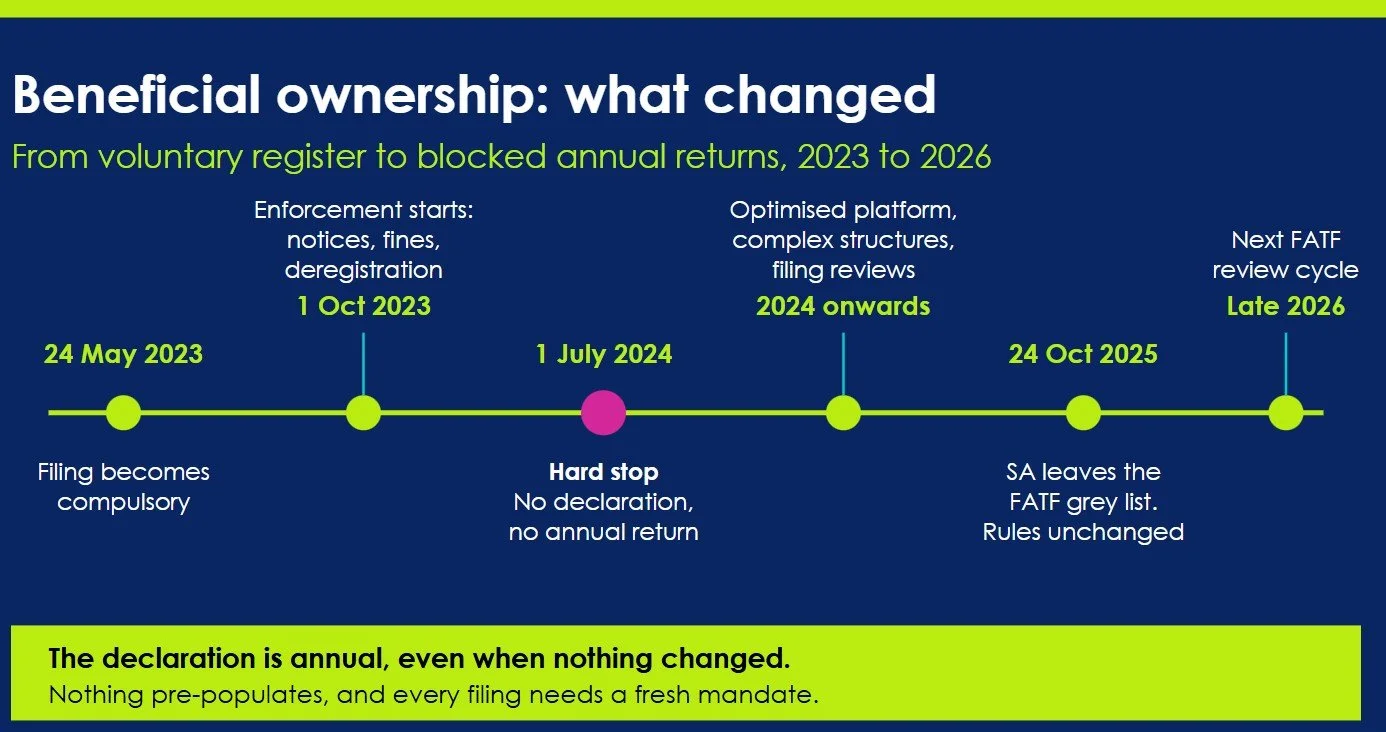
Beneficial ownership filing became compulsory on 24 May 2023. Three things have happened since that alter how you work.
Enforcement started on 1 October 2023. The CIPC has published lists of non-compliant entities, issued compliance notices and administrative fines, and moved to deregister entities that ignore both.
From 1 July 2024 a hard stop was implemented. No beneficial ownership declaration, no annual return. A client whose ownership data is wrong on CIPC records cannot file an annual return at all until it is fixed.
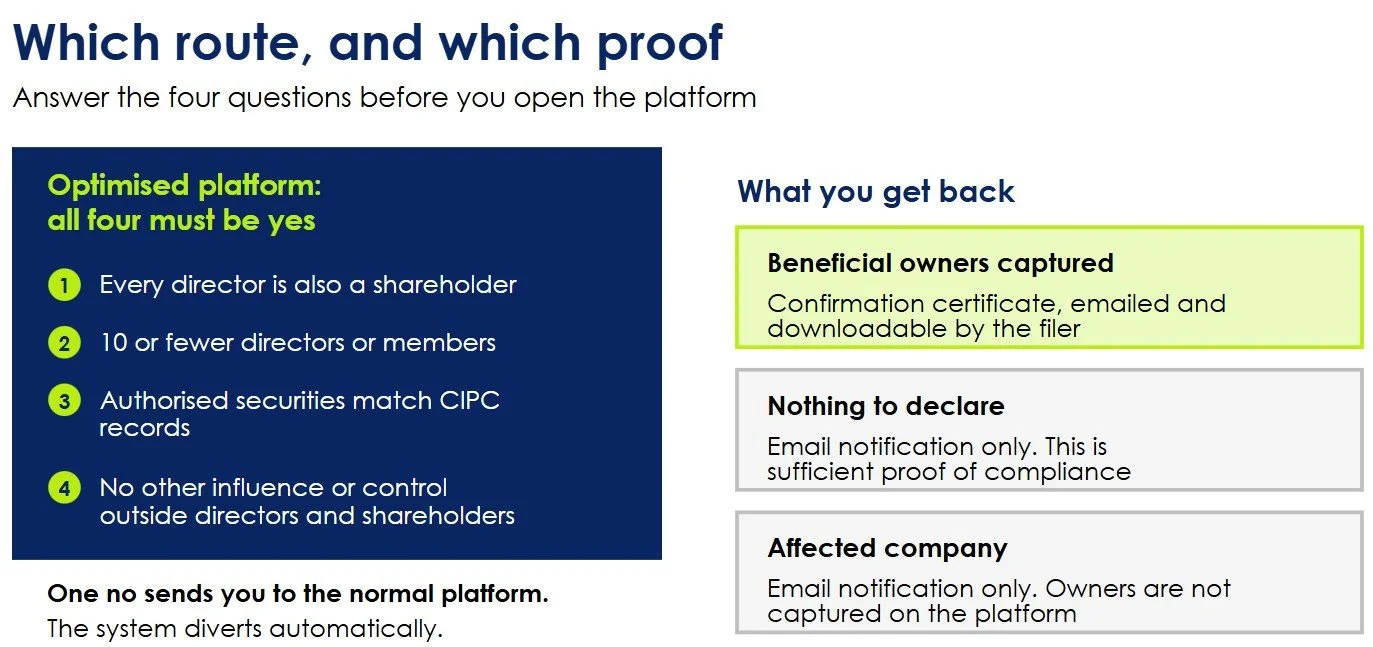
The optimised platform was provided for smaller entities. No document uploads, no certificate to chase, and the whole filing takes minutes, as we covered in our article: Optimized Beneficial Ownership Filing System. It is only available if every director is also a shareholder, there are 10 or fewer directors or members, the authorised securities match CIPC records, and no other influence or control exists outside the directors and shareholders. Fail any one of those and the system diverts you to the normal platform.
South Africa came off the FATF grey list on 24 October 2025. The reporting, however, carries on, with the next review cycle starting from late 2026, and it tests whether the register is accurate. That is a question about individual filings, which is a question about your work.
The frequently asked questions
Why must we capture everything again each year?
Because the information is personal information under POPIA and a new filer would not be entitled to see what a previous filer submitted. Nothing pre-populates. The CIPC says it is working on pre-populating the fields that are not personal information.
We got a notification, not a certificate. Our bank wants a certificate.
A confirmation certificate is issued only where beneficial owners were actually captured on the platform. Non-affected entities with nothing to declare, and affected companies, receive an email notification, and that notification is proof of compliance. Banks read the register directly in real time. The CIPC cannot issue a certificate that does not exist for that filing type.
How do we actually put the mandate in place?
There is no CIPC form or template: a letter, a directors' resolution, an affidavit or a power of attorney all work. The content is what matters, so the document must show the client's name, registration number, registered address and contact details, name the individual who will file with their ID number and the mobile number and email that will receive the one-time pin, state that the entity authorises that person to submit its beneficial ownership declaration, carry a date, and be signed by 50% plus one of the directors, or by all members of a close corporation.
That signature count is where filings normally stall. If you have three directors, you need two signatures. Five directors mean three signatures. One director signing for a board of five is not a valid mandate. Get it signed before you open the platform, then save it to the client file. Next year's declaration needs a fresh one.
Can we mandate our firm to file?
No. A mandate can only be given to a human being. Your firm is a juristic person, so it cannot hold one. Name the individual in the firm who will do the filing, and they file as the mandated person. One mandate covers one filing. Next year's declaration needs a new mandate, dated for that filing, even if the same person in your firm is doing it.
Our authorised shares show zero after a conversion.
The optimised platform pulls that figure from CIPC records in real time, so the record must be corrected first. Send proof of the actual authorised securities to the MOI Amendments Division, then file.
A trust holds the shares.
Declare the trustees and the beneficiaries as natural persons. Not the trust. Not its representative. Where the list is long, set it out on a dated disclosure form, as covered when the CIPC extended the service to complex structures.
Only the filer gets the OTP.
Confirmed, and it stays that way. Chasing pins from ten beneficial owners would stall every complex filing.
The one that matters for construction and government supply
A practitioner asked why the Central Supplier Database keeps referring clients back to the CIPC because it cannot see black ownership in the beneficial ownership data.
It never will. Beneficial ownership is wider than shareholding because it includes control, so it cannot be reconciled to a B-BBEE ownership analysis. After engagements between the CIPC, National Treasury and the CSD, the CSD will check only whether an entity has filed. It will not compare content.
If you act for contractors, suppliers or service providers bidding for state work, that is worth knowing before your client loses a tender window arguing with the wrong regulator.
What to do this week
Pick your three largest clients and check four things before their next annual return falls due: authorised securities against CIPC records, director and member contact details for OTP delivery, whether every director is also a shareholder, and whether the confirmation certificate or notification from last year is on file. Fixing those four now takes an hour. Fixing them while an annual return is blocked takes a fortnight and an unhappy client.
Then price it. Beneficial ownership filing is annual, it is mandatory, it blocks the annual return, and most clients cannot do it themselves. That is a billable service, not a favour.
For more information download CIPC’s Beneficial Ownership webinar slides here. The webinar will be posted to CIPC’s YouTube channel shortly.
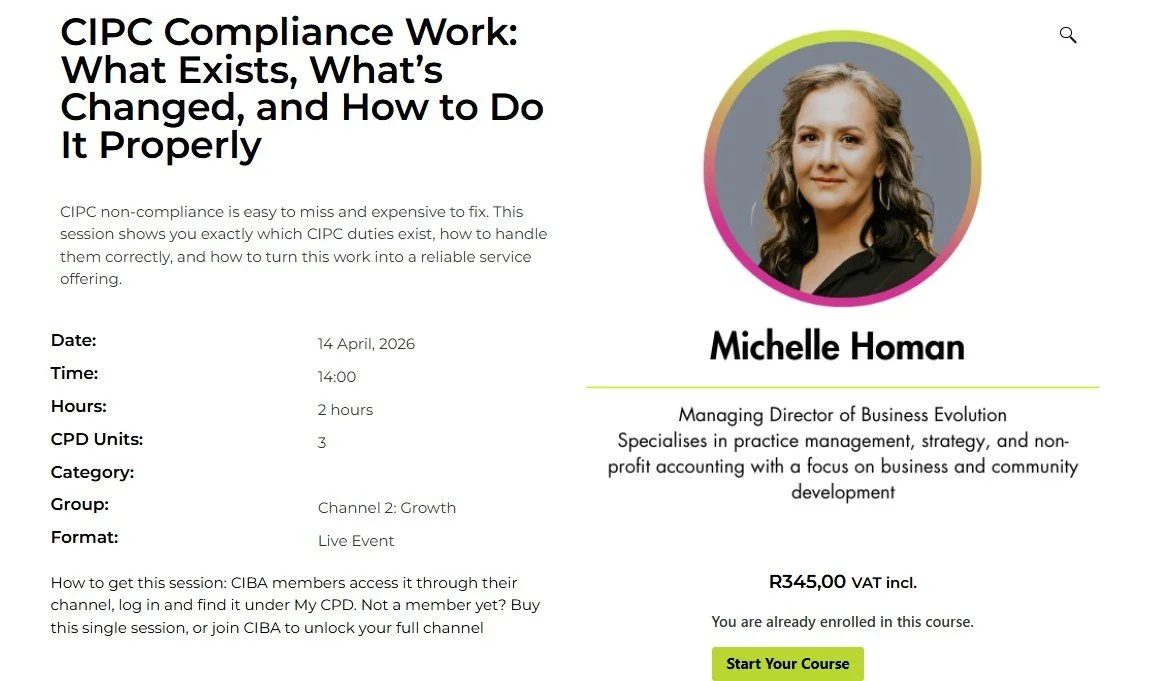
Tune into CIBA webinar on CIPC Compliance Work: What Exists, What’s Changed, and How to Do It Properly and learn more about how to service clients and avoid problems.
By attending this event, you will learn:
Which CIPC compliance requirements apply to companies and close corporations
How to manage company registrations correctly
How to process director appointments, resignations, and changes
How and when financial year-end changes can be made
How to complete and submit annual returns correctly
What beneficial ownership declarations are and why they matter
Common CIPC errors that trigger penalties or deregistration
How to confidently offer CIPC compliance as a client service