
This article will count 0.25 units (15 minutes) of unverifiable CPD. Remember to log these units under your membership profile.
SARS wants R126 billion of outstanding tax debt collected this year, and the businesses most likely to feel it are the small ones that accountants in practice look after every day.
Speaking at the South African Institute of Taxation's Tax Indaba in September, SARS Commissioner Johnstone Makhubu said the country's tax debt book now stands at more than R600 billion. SARS regards R280 billion of that as collectable, and the R126 billion target is drawn from that amount.
The timing is hard on clients. The Reserve Bank raised the repo rate on 23 September, and petrol crossed R30 a litre for the first time on 7 October. Many owner-managed businesses that fell behind on VAT or PAYE to keep the doors open are now being asked to pay at the moment their cash is tightest.
A final demand now means what it says
Practitioners have seen the change on the ground. Jashwin Baijoo, a partner at Tax Consulting South Africa, says SARS now issues a letter of final demand for debts as small as R5,000. He describes the past 18 months as a sustained collection drive.
A few years ago, a final demand was often where things stopped, even for debts running into millions. Now SARS follows through. If the debt goes unpaid, it appoints third parties such as banks to pay over funds, obtains civil judgments, issues garnishee orders and, for companies, pursues directors personally.
Penalties are a large part of the problem. SARS has said more than R25 billion of current tax debt is made up of administrative penalties, and Makhubu told the Indaba that SARS is comparing its penalty regime with those of some OECD countries. Tax Consulting SA gives the example of a R2 million liability that can grow to R10 million once understatement penalties and interest are added.
Why nine in ten relief applications fail
In 2025 SARS introduced an Expedited Tax Debt Process with the recognised controlling bodies, which include CIBA. It lets taxpayers settle non-disputed debts older than 12 months through the debt compromise mechanism.
The uptake has not gone well. According to Makhubu, almost 90% of applications were rejected because applicants could not show financial hardship. In many cases their bank balances showed they could afford far more than they had offered.
Makhubu warned that relief programmes must not become a way for taxpayers to "play games" with SARS. The lesson for practitioners is that a compromise application is a hardship case, and it needs the evidence to prove it. The burden of proof rests with the taxpayer.
Ten business days to choose a route
A taxpayer who receives a final demand has 10 business days to respond. Depending on the facts, there are four main routes.
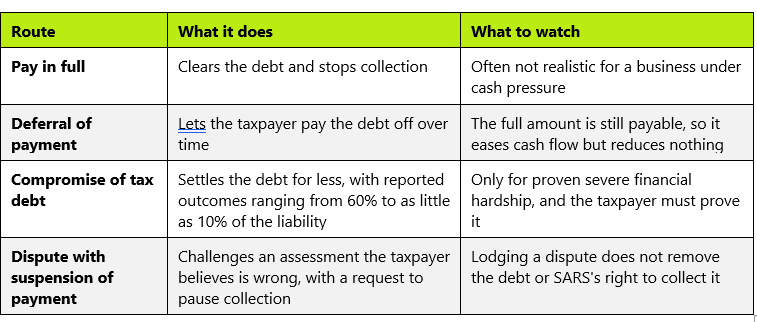
The choice matters. Applying for relief means the taxpayer accepts the debt in full. A taxpayer with a genuine case against the assessment can dispute it first and look at relief later, depending on the outcome.
André Daniels, head of tax controversy at Tax Consulting SA, advises practitioners to ask SARS for its reasons before objecting. The grounds set out in an objection can bind the taxpayer on appeal, so a weak argument at that stage is hard to fix later.
What practitioners can do before the letter arrives
The practitioners who serve these clients best will be the ones who act before SARS does. That starts with knowing which clients carry old debt, including debt from audits that may go back many years.
Run a tax debt check across the client base and flag any balance older than 30 days, which is when an amount legally becomes a tax debt.
Separate debts the client disputes from debts they accept, because the route for each is different.
For any client considering a compromise, gather the financial evidence now: bank statements, cash-flow forecasts and proof of hardship.
Agree in advance who acts, and how, if a final demand lands, because the 10-day window leaves little room.
Review penalty notices for remission grounds before they add to the balance.
With rates up and fuel at a record, more clients will fall behind in the months ahead. SARS has made its position clear, and a client who hears about this from their accountant first is in a far better position than one who hears about it from their bank.
Sources
SARS eyes higher tax debt collections: relief is available, but playing games will not fly, Polity, 1 October 2026
SARS sets out vision for the next era of tax administration at Tax Indaba 2026, SARS, 14 September 2026
R3.28 per litre petrol price hike for South Africa this October, TopAuto, October 2026
R3 per litre pain for petrol prices in October, BusinessTech, 25 September 2026