This article will count 0.25 units (15 minutes) of unverifiable CPD. Remember to log these units under your membership profile.
On 31 July 2026 the Financial Intelligence Centre published Directive 10 on information pertaining to geographic locations. Directive 10 tells specified accountable institutions to hand over detailed information about every physical location they operate from, head office and every branch inside and outside South Africa. Every subsidiary's head office, here or abroad. And if a subsidiary has its own branches, those too.
For each location the FIC wants the name, the licence number where one exists, the registration number where one exists, the business address, and the name and contact details of the person carrying out the compliance function at that location.
The reason is supervision. The FIC says knowing where an institution actually sits, and how its group hangs together, lets it target inspections at the places where money laundering and terrorist financing risk is highest. Location and structure either raise your risk profile or lower it. Until now the FIC has been guessing.
Alongside the legal text, the FIC also released a plain-language information sheet, a one-page illustrated summary aimed at people who do not read gazettes for fun.
Check whether it applies to you first
The December 2025 draft applied to every accountable institution in Schedule 1. Industry pushed back hard. The final version is much narrower.
Nine accountable institution categories are in scope: legal practitioners, trust and company service providers, estate agents, gambling institutions, credit providers other than banks and mutual banks, the South African Post Bank, high-value goods dealers, the South African Mint Company, and crypto asset service providers.
Read item 2 again.
If your accounting practice registers companies at CIPC for clients, sets up or administers trusts with the Master of the High Court, or arranges nominee shareholder structures, you are almost certainly a Trust and company service provider. We unpacked exactly where that line falls in Are You FIC-Registered? What Every Accountant Must Know Now. That single company registration you did as a favour last year is what pulls you into Directive 10 now.
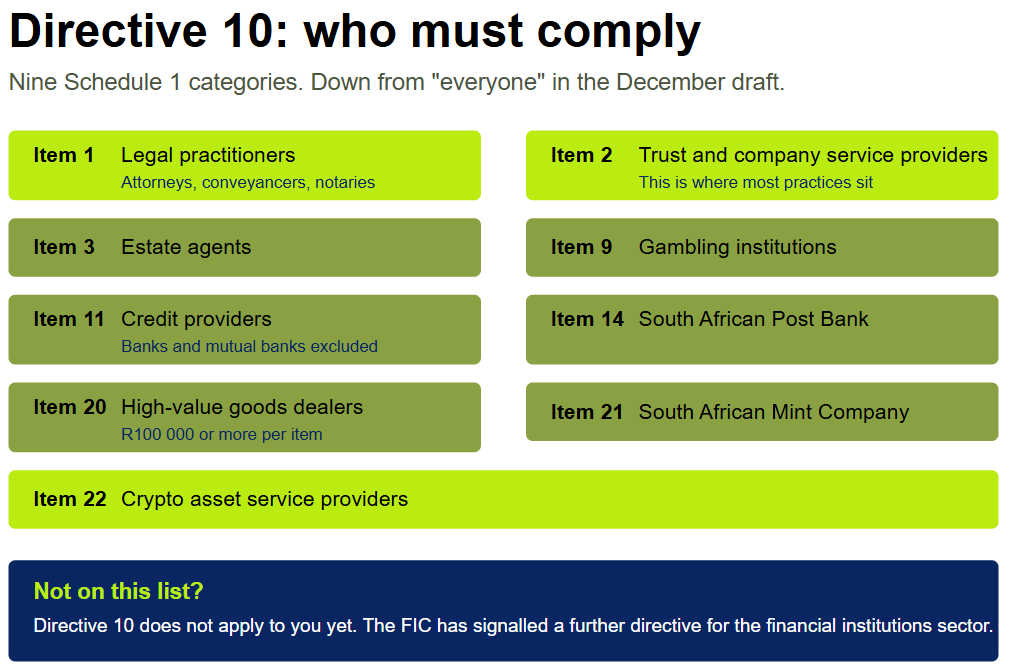
Banks argued for an exemption on the grounds that the Prudential Authority already holds this data. The FIC said no, the information serves a different regulatory purpose, but then confined the final directive to designated non-financial businesses and professions anyway. A separate directive for the financial sector is coming.
The definition of "branch" got much smaller
This is the part worth knowing, because it saves you work. Commentators warned the draft would force institutions to list thousands of locations, including server rooms and call centres. The FIC agreed that was never the plan.
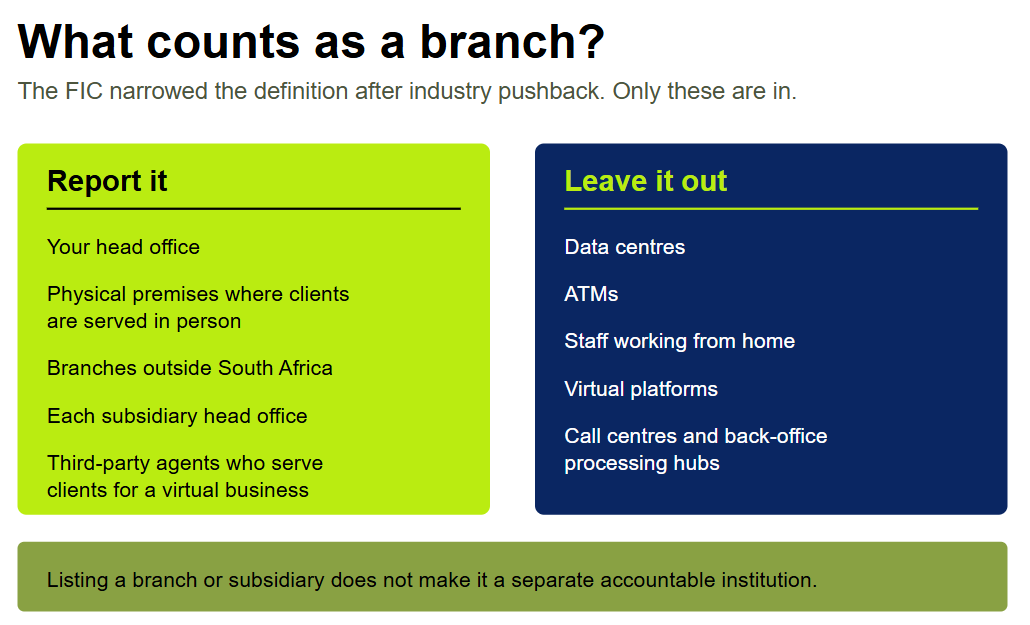
A branch, for Directive 10 purposes, is physical premises where Schedule 1 products and services are provided directly and in person to clients. Data centres are out. ATMs are out. Staff working from home are out. Virtual platforms are out.
Two useful edge cases. If a business runs mainly through a virtual platform but uses third-party agents to sign up and serve clients, those agents' branches must be listed. And a purely virtual business still has to disclose the head office it operates from.
Listing a branch or subsidiary does not turn it into a separate accountable institution. It is disclosure, not a new registration.
The 90-day clock
If you were already registered with the FIC on 31 July 2026 and you fall in scope, you have 90 days to update your registration. That lands on 29 October 2026.
After that, any change to any of those particulars must reach the FIC within 90 days of the change. A new branch, a moved office, a compliance officer who resigns. All of it.
Miss it and you are non-compliant, with administrative sanctions available under sections 45C and 61A of the FIC Act. That is not theoretical. The FIC's Appeal Board upheld a R266 000 penalty against an estate agency for compliance failures, including R50 000 for a single directive breach, and made the point that fixing the problem after an inspection does not cancel the sanction. We covered that ruling in FIC Upholds Penalties on Estate Agency for Compliance Failures.
How to actually submit it
The FIC information sheet sets out four steps:
Log into the head office goAML profile.
Go to the active organisations tab.
Choose to create a new delegating organisation.
Enter the geographic location information for that branch or subsidiary
Where the money is
Here is the part your competitors will miss.
Your client base is full of businesses sitting squarely in these nine categories. Estate agencies with three area offices. A jewellery or motor dealer moving stock above R100 000 an item. A micro-lender with branches in four townships. A crypto platform with agent networks. Every one of them now has a mapping exercise, a data-gathering exercise, and a goAML submission to complete before 29 October.
Most of them do not know it yet. Estate agents in particular are already under pressure from the PPRA on FIC compliance, as we reported in Estate agents reminded of FIC compliance expectations, and many simply do not have the internal capacity.
You do. You already hold their CIPC records, their addresses, their group structures. Turning that into a Directive 10 location register is billable work you can quote for this week. And it opens the door to the bigger conversation about RMCPs and risk and compliance returns that Directive 11 is driving.
This is exactly how compliance pressure becomes advisory income. Not by absorbing the admin quietly, but by naming the deadline, scoping the work, and sending an invoice.
Do this today
Confirm whether your own practice falls under item 2 as a TCSP. If yes, you are in scope.
List every location where you or your client physically serves clients. Ignore server rooms, home offices and virtual platforms.
For each location, gather five things: name, licence number, registration number, business address, and the compliance function contact.
Load it through the head office goAML profile before 29 October 2026.
Email your estate agent, credit provider, high-value goods and crypto clients this week. Tell them the deadline. Quote the work.
The accountants who send that email in August will be paid for it. The ones who send it in late October will be doing it for free, at midnight, under pressure.
👉 Join CIBA and we will show you how to turn FIC deadlines into a service clients happily pay for.